What Is an Avulsed Tooth?

Avulsion of a permanent tooth is a true dental emergency. Time is absolutely of the essence – the chance of a successful treatment declines with every minute you wait. Knowing exactly what to do and preparing in advance could make the difference between a tooth that can be saved and one that can’t, so take this opportunity now to learn about avulsed teeth and what to do if your child has one!
What Is Tooth Avulsion in Children?
When a child’s tooth is knocked completely out of its socket in a traumatic injury, dentists refer to it as an “avulsed tooth.” An avulsed tooth is one of the most serious dental injuries and requires immediate care.
What to Do If Your Child’s Tooth Gets Knocked Out
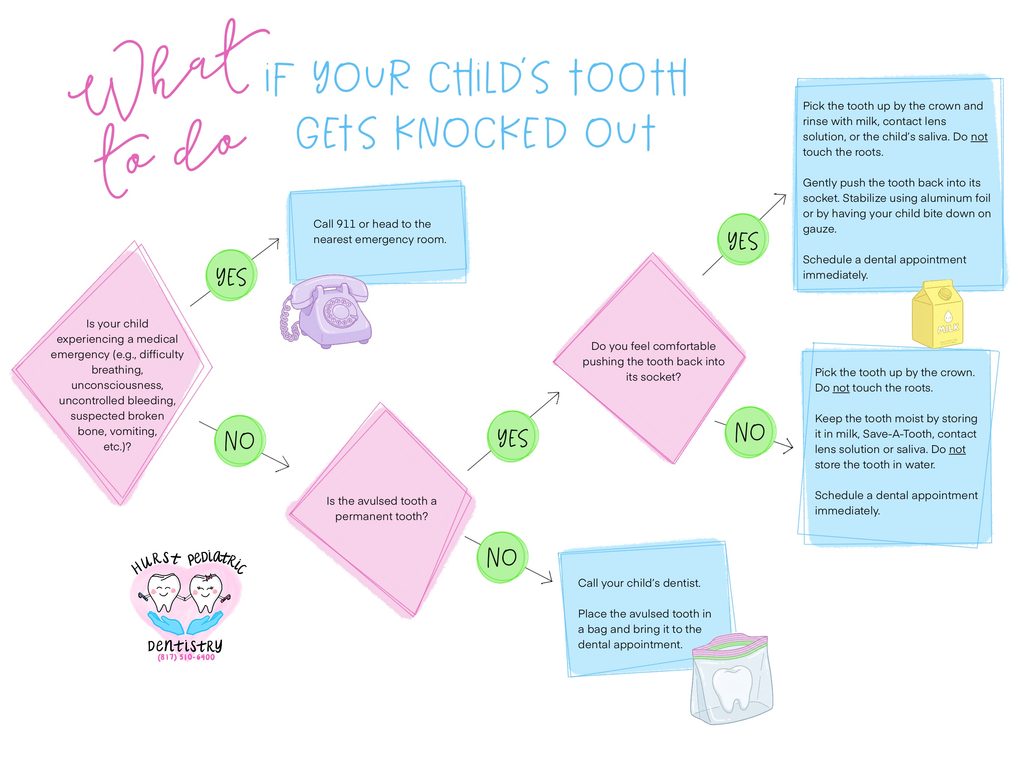
First off, if your child is suffering from serious medical injuries in addition to an avulsed tooth, medical care should be prioritized over dental care. Call 911 or go to the nearest emergency room if your child is experiencing a medical emergency, including any of the following:
• Loss of consciousness
• Confusion/disorientation
• Choking
• Difficulty breathing
• Uncontrolled bleeding
• Nausea/vomiting
• Suspected broken bone
If your child does not require immediate medical care, the first priority is to locate the avulsed tooth, if possible.
If a Baby Tooth Is Knocked Out
• Call your child’s pediatric dentist to schedule an emergency dental appointment.
• Do not attempt to place the tooth back into its socket. Instead, put the tooth in a plastic bag and bring it with you to the appointment.
If a Permanent Tooth Is Knocked Out
• Pick the tooth up by its crown (the part of the tooth that’s normally visible). Avoid touching the tooth’s root (the pointy part of the tooth that is normally hidden under the gums).
• Rinse the tooth off with milk, contact lens solution, or the child’s own saliva.
• Gently push the tooth back into its socket using your thumb, making sure the tooth is facing the correct direction. After you’ve pushed it back in, stabilize the tooth by having your child bite down on gauze or a small piece of cloth. Although pushing the tooth back into its socket right away is ideal, if you are unable to push the tooth back into its socket or feel uncomfortable doing so, you can store the tooth in milk, contact lens solution, or Hank’s Balanced Salt Solution (used in products such as Save-A-Tooth). Alternatively, you can place the tooth on a piece of plastic wrap and have your child spit on it; then wrap the tooth tightly and allow the saliva to keep it moist. Do not store the tooth in water.
• Call your child’s pediatric dentist immediately. Prompt treatment is critical. If your pediatric dentist’s office is closed, seek care elsewhere and follow up with your child’s regular pediatric dentist later. If you are located in this area (Hurst, Colleyville, Euless, Bedford, Keller, etc.), Cook Children’s Hospital in Fort Worth has a pediatric dentist on call to help with after-hours dental emergencies. Be sure to bring the avulsed tooth to your child’s emergency dental appointment.
Can a Knocked-Out Permanent Tooth Be Saved? Why Every Step Matters
In most cases, the ultimate goal with respect to an avulsed permanent tooth will be to reattach the tooth. The ability of the tooth to successfully “replant” (i.e., reattach to the gums) depends in part on a particular type of cell found on the tooth’s roots – namely, periodontal ligament cells (“PDL cells”).
The above rules are intended to maximize the likelihood of the PDL cells remaining healthy and viable, and consequently the likelihood that the tooth can be replanted successfully. The longer a child’s tooth remains out of its socket, the more likely it is the PDL cells will die; touching the tooth’s roots risks damaging the PDL cells; and storing the tooth in milk, contact lens solution, Save-A-Tooth, or saliva increases the PDL cells’ chance of survival.
How Is an Avulsed (Knocked-Out) Baby Tooth Treated?
If one of your child’s primary teeth gets knocked out, your child’s pediatric dentist will perform an examination and take X-rays to look for additional damage, including damage to the replacement permanent tooth. If you and your child were unable to locate the avulsed tooth, your child’s dentist will check to see if it got pushed into the child’s lip, cheek, gums or tongue. 1
If the dental exam does not reveal any additional damage, your child’s dentist may recommend simply monitoring to make sure the replacement permanent tooth is able to erupt properly.
How Is an Avulsed Permanent Tooth Treated? Reimplantation and Follow-Up Care
If the avulsed tooth is a permanent tooth, your child’s dentist may be able to replant it. If the dentist determines that attempting to replant is advisable, he or she will clean both your child’s gum tissue and the avulsed tooth and then gently press the tooth back into the socket.
Alternatively, if you have already placed your child’s tooth into the socket prior to the appointment, the dentist will confirm that the positioning of the tooth is correct. In either case, the dentist will stabilize the replanted tooth with a splint and will prescribe an antiseptic mouthwash to help with the healing process and possibly an antibiotic to help prevent infection.
Very importantly, you will need to bring your child back for follow-up visits as directed by your child’s dentist so the dentist can properly monitor the healing process and check for infections. The hope with a replanted permanent tooth is that the injury will heal and blood flow will be restored to the tooth’s dental pulp (the soft, gelatinous substance in the center of the tooth). However, children’s bodies do not always restore the blood flow, especially if the tooth was outside of the socket for an extended period or if the tooth was stored in less-than-ideal conditions (see the discussion of PDL cells above). Bringing your child to all scheduled follow- ups is crucial for allowing the dentist to monitor the dental pulp and perform pulp therapy if needed.
Can You Reattach a Knocked-Out Baby Tooth?
You may be wondering, “If avulsed permanent teeth often get replanted, do primary teeth get replanted, too?” The answer is “no”, in large part because reattaching a primary tooth can potentially damage the replacement permanent tooth or prevent that permanent tooth from erupting properly.
How to Prepare for a Knocked-Out Tooth: A Parent’s Dental Emergency Checklist
When it comes to a child’s tooth getting knocked out, prompt action is critical. Advance preparation can make all the difference. Steps you can take to prepare yourself include the following:
- Save your child’s pediatric dentist’s office number in your phone.
- Determine who you can call in the event of an after-hours dental emergency. If you
are in this area (Hurst, Colleyville, North Richland Hills, etc.), Cook Children’s Hospital in
Fort Worth has a pediatric dentist on call for after-hours dental trauma. In addition to helping with the avulsed tooth, the hospital will be able to treat any medical issues resulting from the injury. - Print the below flow chart and keep it somewhere where you’ll be able to access it easily for future reference.
- Consider keeping saline solution and a Ziploc bag in your car or purse, in case you ever need to store an avulsed tooth when you’re out. You could use a simple contact lens solution, or an ADA-accepted dedicated solution for avulsed teeth, such as Save-A-Tooth. Medical gauze would also be useful in the event you ever need to temporarily stabilize an avulsed tooth.
Treatment for Pediatric Dental Trauma in Hurst, TX
If your child’s tooth was knocked out, call our office as soon as possible at 817-510-6400. Dr. Lin is a board-certified pediatric dentist with significant experience in treating avulsed teeth in children. He completed his pediatric dental specialty training at Boston Children’s Hospital and the Harvard School of Dental Medicine, where he worked on cases involving complex pediatric dental trauma, and he has helped many pediatric patients with avulsed teeth since opening his practice here in Hurst, Texas.
This article is intended to provide general information about oral health topics. It should not be used
to diagnose or treat any disease or as a substitute for the advice of a healthcare professional who is
fully aware of and familiar with the specifics of your case. Always seek the advice of your dentist or
other qualified healthcare provider with any questions you may have regarding a medical condition or treatment.
- An avulsed tooth can also get swallowed, aspirated, or pushed up into the child’s nose. If the
tooth’s location remains unknown after the dental examination, your child may be referred for
a medical evaluation to make sure the tooth is not inside your child’s airways. ↩︎